Table Of Contents
- What Is a Rent Agreement?
- Important Tenant Rights Mentioned in a Rent Agreement
- Right to Occupy the Property During the Agreed Period
- Right to Know the Rent and Increase Terms
- Right to Security Deposit Transparency
- Right to Privacy and Peaceful Occupation
- Right to Clarity About Repairs and Maintenance
- Protection Against Unlawful Eviction
- Right to Clear Utility and Maintenance Charges
- Right to a Written Record of the Tenancy Terms
- Right to Fair Treatment Under Applicable Law
- Important Clauses Tenants Should Check Before Signing
- How to Make a Rent Agreement Online Through eDrafter
- Frequently Asked Questions (FAQs)
- Final Takeaway
Renting a house is common in India, whether for work, education, or family needs. However, tenants should understand their rights before moving into a rented property. A rent agreement helps protect both the tenant and the landlord by clearly explaining the terms and conditions of the tenancy.
A well-drafted rent agreement can help prevent disputes related to rent increases, security deposits, repairs, privacy, and eviction. Understanding these rights can help tenants make informed decisions and avoid unnecessary legal problems.
What Is a Rent Agreement?
A rent agreement is a written document between a landlord and a tenant that sets out the conditions for renting a property. It generally includes the monthly rent, security deposit, tenancy period, maintenance responsibilities, notice period, and other agreed terms.
In India, tenancy laws vary by state and union territory. The Model Tenancy Act, 2021, was circulated to states and union territories for adoption; it does not automatically apply uniformly throughout the country. Tenants should check the applicable local law before relying on a particular provision.
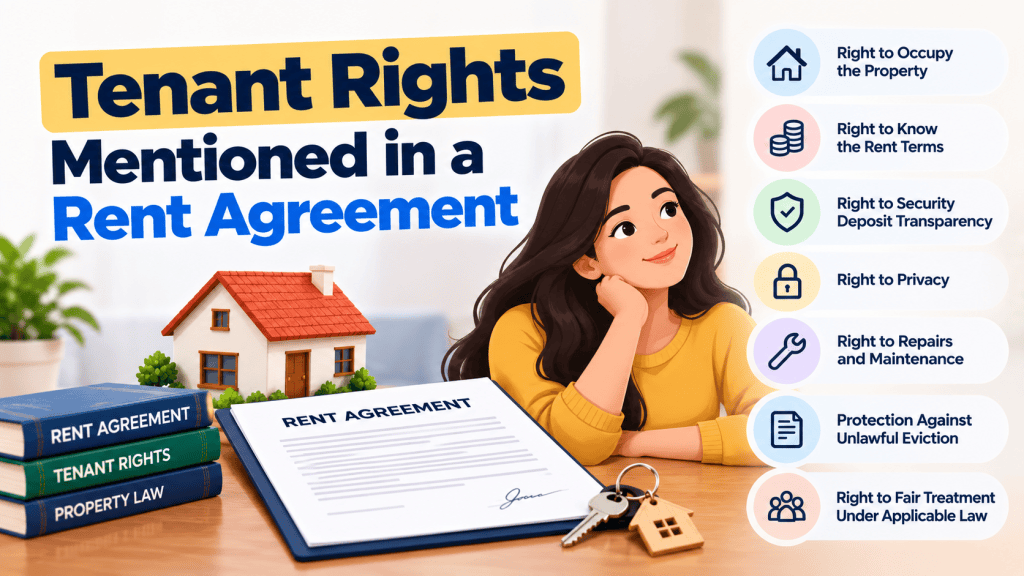
Important Tenant Rights Mentioned in a Rent Agreement
1. Right to Occupy the Property During the Agreed Period
A tenant is generally entitled to occupy the rented property according to the terms of the agreement, provided the tenant follows the applicable conditions and law.
The agreement should clearly mention the starting date, duration of tenancy, and conditions for renewal or termination. This helps both parties understand their obligations.
2. Right to Know the Rent and Increase Terms
The rent agreement should specify the monthly rent, payment date, accepted payment method, and any late-payment terms.
It should also explain whether rent can increase during the tenancy and how such an increase will be determined. A landlord should not assume that rent can be increased at any time without considering the agreement and applicable law.
3. Right to Security Deposit Transparency
A security deposit is commonly collected to cover specified outstanding dues or damage beyond ordinary wear and tear, subject to the agreement and applicable law.
The agreement should mention:
- The amount of the security deposit.
- The conditions under which deductions may be made.
- The process and timeline for returning the deposit.
- How unpaid rent, utility bills, or property damage will be handled.
Tenants should request a written record of the deposit payment and retain the receipt or transaction proof.
4. Right to Privacy and Peaceful Occupation
Tenants should be able to use the rented home peacefully during the tenancy. The landlord’s access to the property should follow the agreement and applicable law.
The agreement can specify reasonable notice before inspections, repairs, or maintenance visits, except where urgent circumstances or legal requirements apply.
Tenants should also understand that the right to privacy does not remove lawful access rights available to the landlord.
5. Right to Clarity About Repairs and Maintenance
Repair responsibilities should be clearly divided between the landlord and the tenant.
For example, the agreement may explain who is responsible for structural repairs, plumbing problems, electrical faults, routine maintenance, and damage caused by the tenant.
Section 108 of the Transfer of Property Act, 1882, contains certain default rights and responsibilities of lessors and lessees, subject to the law’s conditions and any applicable contract or local usage. The precise position depends on the tenancy and applicable legal framework.
6. Protection Against Unlawful Eviction
A landlord and tenant should follow the applicable law and the agreement when ending a tenancy.
The agreement should specify the notice period, termination conditions, and procedure for handing over the property. A landlord should not assume that changing locks, removing belongings, or using force is a lawful substitute for the required legal process.
The grounds for eviction and the procedure to be followed depend on the applicable tenancy law and the facts of the case.
7. Right to Clear Utility and Maintenance Charges
The rent agreement should explain who pays for electricity, water, gas, internet, society maintenance, parking, and other charges.
Tenants should understand which charges are included in the monthly rent and which must be paid separately. Written clarity can help avoid disputes over unexpected bills.
8. Right to a Written Record of the Tenancy Terms
A written agreement helps establish the terms accepted by both parties. Tenants should receive a copy of the signed agreement and keep payment receipts, deposit records, and written communication about important changes.
The agreement should accurately identify the parties and property and include the terms agreed upon for rent, duration, maintenance, deposit, and termination.
9. Right to Fair Treatment Under Applicable Law
Tenants can seek legal remedies if a landlord breaches the agreement or violates applicable tenancy law. Depending on the issue, the appropriate remedy may involve a rent authority, court, consumer forum, or another competent authority.
Tenants should keep evidence of the issue and seek legal advice when necessary rather than relying on assumptions about their rights.
Important Clauses Tenants Should Check Before Signing
Before signing a rent agreement, review these points carefully:
- Rent and deposit: Confirm the amounts and payment terms.
- Tenancy period: Check the start date, end date, and renewal conditions.
- Notice period: Understand the process for ending the tenancy.
- Maintenance: Confirm who handles repairs and routine expenses.
- Restrictions: Review rules concerning pets, guests, subletting, and property use.
- Stamp duty and registration: Check the applicable legal requirements for the agreement.
- Property condition: Record existing damage and, where possible, keep photographs.
How to Make a Rent Agreement Online Through eDrafter
Tenants and landlords can begin preparing their rent agreement online through eDrafter.
- Visit the eDrafter Rent Agreement page.
- Select the suitable service option for your requirements.
- Enter the tenant’s, landlord’s, and property’s details.
- Review the rent, deposit, duration, maintenance, and notice-period clauses.
- Complete the selected service and follow the applicable stamping, signing, notarisation, or registration requirements.
Before finalising the agreement, both parties should check that the terms are accurate and suitable for their tenancy. Online preparation does not remove any mandatory legal formalities.
Frequently Asked Questions (FAQs)
1. Is a rent agreement necessary for tenants in India?
A written rent agreement is strongly advisable because it records the agreed terms. Specific documentation, stamping, and registration requirements depend on the type and duration of the tenancy and the applicable law.
2. Can a landlord increase rent whenever they want?
Not necessarily. Rent increases are governed by the agreement and applicable tenancy law. Tenants should check the rent revision clause before signing.
3. Can a landlord evict a tenant without notice?
The applicable procedure depends on the tenancy and local law. Tenants should not assume that a landlord can bypass legal requirements simply by asking them to leave immediately.
4. What can a tenant do if the landlord does not return the security deposit?
The tenant should review the agreement, request an explanation of any deductions in writing, and retain payment records. If the dispute remains unresolved, the tenant may seek an appropriate legal remedy.
5. Do tenant rights remain the same across India?
No. Tenant rights and remedies can differ across states and union territories. The applicable tenancy law, the agreement, and the facts of the situation determine the rights available.
Final Takeaway
A rent agreement is more than a record of monthly rent. It helps tenants understand their rights, responsibilities, and available remedies while providing clarity to landlords. Before signing, carefully review the rent, security deposit, repairs, privacy, notice period, and termination clauses.
A clear, properly executed agreement can reduce misunderstandings and make renting a property more transparent for everyone.
Disclaimer: This article is for general informational purposes only and does not constitute legal advice. Tenant rights and rent agreement requirements vary by jurisdiction and individual circumstances. Consult a qualified legal professional for advice on a specific dispute.


Leave a Reply